15 Glasgow Hotels in Railway Offices, a Church and a Customs House
The station hotel where the first long-distance television pictures arrived in 1927, the Anchor Line’s booking hall, a church of 1839 turned hotel, and the mansion that became a hospital for limbless servicemen in 1916.
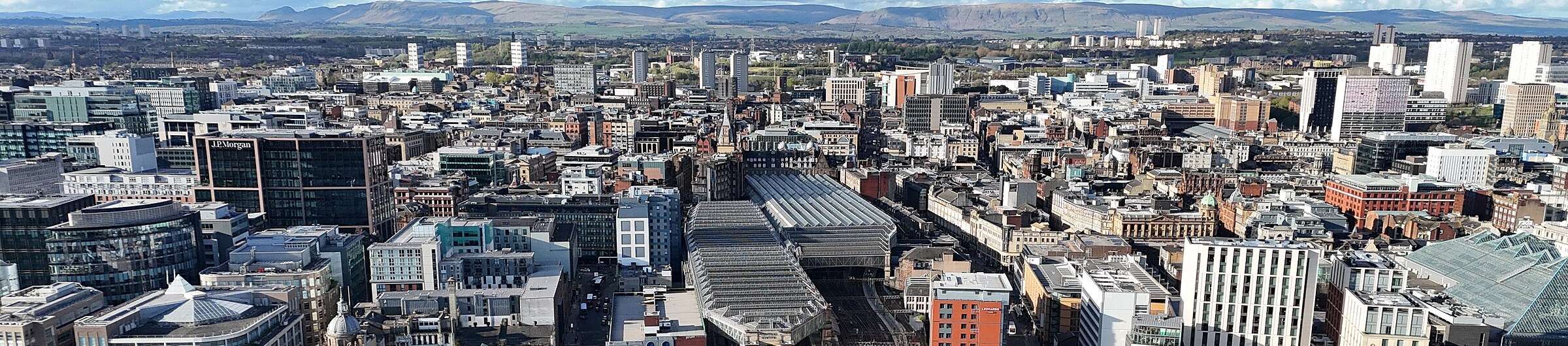
Glasgow’s hotels sit in the buildings the railway, the shipping lines and the customs service left behind. This list has the Grand Central, where John Logie Baird received the first long-distance television pictures in 1927, Native Glasgow in the Anchor Line’s 1907 headquarters, the Malmaison in a church of 1839, and Mar Hall, the mansion that became the Princess Louise Scottish Hospital in 1916.
The list is grouped by character, not ranked. Where a hotel’s own site could be confirmed, its name links there; the rest are listed without one.
Railway, shipping and the Clyde
voco Grand Central Glasgow · City centre / Central Station
The Grand Central opened in 1883 as the Caledonian Railway’s Central Station Hotel, designed by Robert Rowand Anderson and joined to Glasgow Central. In 1927 John Logie Baird received the first long-distance television pictures here, sent down a telephone line from London. Winston Churchill and Frank Sinatra stayed, and Roy Rogers came in 1954 with his horse Trigger.
Grasshoppers Hotel Glasgow · City centre / Central Station
Grasshoppers occupies the top floor of Caledonian Chambers, the listed Caledonian Railway office block by James Miller on Union Street that forms part of Central Station. It opened in 2010, by the hotel’s account, with rooms looking out over the station’s glass roof.
Native Glasgow · City centre / George Square
Native Glasgow is set in the Anchor Line Building on St Vincent Place, built between 1905 and 1907 by James Miller as the headquarters of the Anchor Line transatlantic shipping company. The ground-floor booking hall, where passengers bought passages to New York, is now the restaurant.
Clayton Hotel Glasgow City · City centre / Clyde riverfront
The Clayton is built around the A-listed Custom House of 1840 on Clyde Street, designed by John Taylor for the river’s customs service and later used as the Procurator Fiscal’s office. The old customs hall facing the river is kept as the bar and lounge, by the hotel’s account.
Hotel Indigo Glasgow · City centre / Blythswood
The Indigo occupies a converted Victorian building on Waterloo Street that the hotel describes as a former power station. It sits two minutes’ walk from Central Station, in the Victorian office grid west of Hope Street.
Churches, clubs and the Georgian hill
Kimpton Blythswood Square Hotel · Blythswood Hill
The Blythswood Square occupies the former headquarters of the Royal Scottish Automobile Club on the north side of Blythswood Square, a Georgian square laid out from 1823. Madeleine Smith, tried in 1857 for poisoning her lover with arsenic, lived at No. 7 on the same square.
Malmaison Glasgow · Blythswood Hill
The Malmaison is built around St Jude’s Episcopal Church on West George Street, designed by John Stephen in 1838 and 1839 and now listed. After the Episcopalians left, the church served Glasgow’s Greek Orthodox community, by the hotel’s account. It opened in 1994 as one of the first Malmaisons, launched by the Glasgow hotelier Ken McCulloch.
The Pipers’ Tryst Hotel · Cowcaddens / Townhead
The Pipers’ Tryst is a small hotel inside the National Piping Centre, which opened in 1996 in a former church on McPhater Street. Guests eat beside the Museum of Piping and hear students practising in the teaching rooms, and the profits support the centre’s teaching of the Highland bagpipe, by its own account.
Cathedral House Hotel · Cathedral / Townhead
Cathedral House is a listed Scottish Baronial house of 1877 on Cathedral Square, facing Glasgow Cathedral with the Necropolis behind. It is said to have been built as a halfway house for prisoners released from the neighbouring Duke Street Prison, and is regularly billed as Glasgow’s most haunted hotel.
West End terraces
Hotel du Vin at One Devonshire Gardens · West End / Hyndland
One Devonshire Gardens spreads across five Victorian townhouses on a terrace built in the 1880s off Great Western Road. The hotelier Ken McCulloch opened it in 1986 before going on to found Malmaison and Dakota, and Gordon Ramsay ran his first Scottish restaurant, Amaryllis, here from 2001 to 2004.
Glasgow Grosvenor Hotel · West End / Hillhead
The Grosvenor occupies Grosvenor Terrace, the 1855 Venetian-style terrace by J. T. Rochead on Great Western Road, opposite the Botanic Gardens. A fire in January 1978, during the national firefighters’ strike, gutted the eastern section. The lost section was rebuilt behind a replica facade cast in concrete, by the hotel’s account.
Castles and country houses
Sherbrooke Castle Hotel · Southside / Pollokshields
Sherbrooke Castle is a listed Scottish Baronial mansion of 1896 with turrets and a crenellated tower, in Pollokshields, planned as one of Scotland’s first villas-only garden suburbs. It was built as a private home for the builder John Morrison and has run as a hotel since the mid-twentieth century, by the hotel’s account.
Mar Hall Golf & Spa Resort · outside Glasgow (Bishopton)
Mar Hall was built between 1828 and 1845 as Erskine House for Lord Blantyre, to designs by Sir Robert Smirke, the architect of the British Museum. From 1916 the house was the Princess Louise Scottish Hospital for Limbless Sailors and Soldiers, the origin of the Erskine veterans charity. It became a hotel in 2004, at Bishopton above the Clyde.
Crossbasket Castle · outside Glasgow (High Blantyre)
Crossbasket is a sixteenth-century tower house on the Rotten Calder at High Blantyre, with a Victorian mansion attached. Steve Timoney and Alison Reid restored it and opened it as a hotel in 2016, after years as a children’s home and religious centre, by the hotel’s account. A new wing and a Michel Roux Jr restaurant opened in March 2025.
Gleddoch Golf & Spa Resort · outside Glasgow (Langbank)
Gleddoch is a country house above the Clyde at Langbank, built in the 1920s as the home of the shipbuilder Sir James Lithgow and turned into a hotel with its own golf course in the 1970s, by the hotel’s account. It looks across the river to Dumbarton Rock and the widening Firth of Clyde.
Frequently Asked Questions
Are these hotels ranked?
No. The groups sort them by character, and the order within each group carries no meaning.
What made a hotel interesting enough for this list?
A story. Every entry was a railway, shipping or customs building turned hotel, a church or club with a documented past, a West End terrace with a name attached, or a castle or country house with a history. Comfort alone did not qualify.
Why are there no prices?
Rates change daily and a priced list goes stale in a month. Where a hotel runs its own site, its name links there, so you see the current rate and book direct.
Should I stay in the city centre or the West End?
The city centre puts you by Central and Queen Street stations, George Square and the Merchant City. The West End puts you by the university, Kelvingrove and the Botanic Gardens, fifteen minutes out on the Subway. The castles and country houses are a drive out of town.
Which hotel puts me closest to the day trips on this site?
Most day trips from Glasgow run to Loch Lomond and the Trossachs, Stirling Castle, Glencoe and the Highlands, or across to Edinburgh. The city-centre hotels around Central Station and George Square sit closest to the coach pickups and the trains.